
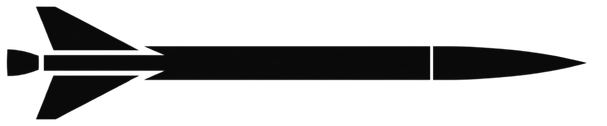
The vehicle
ASTRO-2: our 10K COTS entry for IREC 2027
Single stage. Dual-event, dual-separation recovery. 3U functional payload. Two independent COTS trackers. Flown twice before Midland.
01Specification
Vehicle specification
- Category
- 10K COTS, All Propulsion Types
- Length
- 3.19 m
- Airframe
- 6 in G12 filament-wound fiberglass, 156.7 mm OD, 152.4 mm ID
- Nose cone
- 5:1 Von Kármán fiberglass, aluminium tip
- Fins
- 4 × trapezoidal G10, 4.8 mm, root 350 mm, tip 120 mm, span 150 mm, sweep 200 mm, carbon tip-to-tip layup
- Motor
- AeroTech M2500T-PS in RMS-98/10240; 9,671 N·s total impulse, 2,500 N average thrust, 3.9 s burn
- Pad mass
- 27.5 kg (19.4 kg without motor; includes 1.0 kg removable nose ballast)
- Payload
- 2.27 kg, 3U (100 × 100 × 300 mm)
- Predicted apogee
- 3,223 m (ESRA reference conditions); 3,225 m median Midland weather; range 3,059 to 3,311 m across seven weather cases; trimmed to 3,048 m with the removable ballast after the Texas flight
- Rail exit velocity
- 31.3 m/s on the 5.2 m ESRA rail
- Static margin
- 2.35 cal (11.6 %) at rail exit; 3.57 cal (17.5 %) at burnout
- Max velocity
- 310 m/s (Mach 0.93)
- Max acceleration
- 10.0 g
- Recovery
- drogue at apogee (about 25 m/s); main at 457 m (about 6 m/s at touchdown); recovered mass 22.8 kg
- Simulation
- OpenRocket 24.12, file Astro_2.ork, seven saved simulations
02Subsystems
How it works
Aerostructures
G12 fiberglass airframe chosen for RF transparency and handling robustness. G12 couplers overlap at least one caliber. 4-40 nylon shear pins at the two separation joints; stainless 8-32 screws into bonded backing plates at fixed joints. Stacked G10 bulkheads so every bay is serviced from one end. Fins are 4.8 mm G10 with a carbon tip-to-tip layup; the layup is a structural element: a NACA TN-4197 flutter check shows bare 4.8 mm plate does not reach a 1.5 factor of safety at Mach 0.93, so the layup carries the margin and is rechecked at the PDR with the measured thickness. A larger fin set (170 mm span, 6.35 mm plate) is held as the PDR alternative.
03Recovery
ASTRO-2 Recovery Sequence
- 01
Boost and coast: 3.9 s burn, coast to about 3,220 m (trimmed toward 3,048 m)
- 02
Apogee: the primary altimeter fires the aft charge; the lower joint separates and the 30 in drogue deploys
- 03
Drogue descent at about 25 m/s, all sections tethered
- 04
Main at 457 m: the forward joint separates and the 96 in main deploys from its Nomex bag
- 05
Landing at about 6 m/s; two GPS trackers guide the recovery crew
04Downloads